K. MarkantonakisInformation Security Group, Royal Holloway
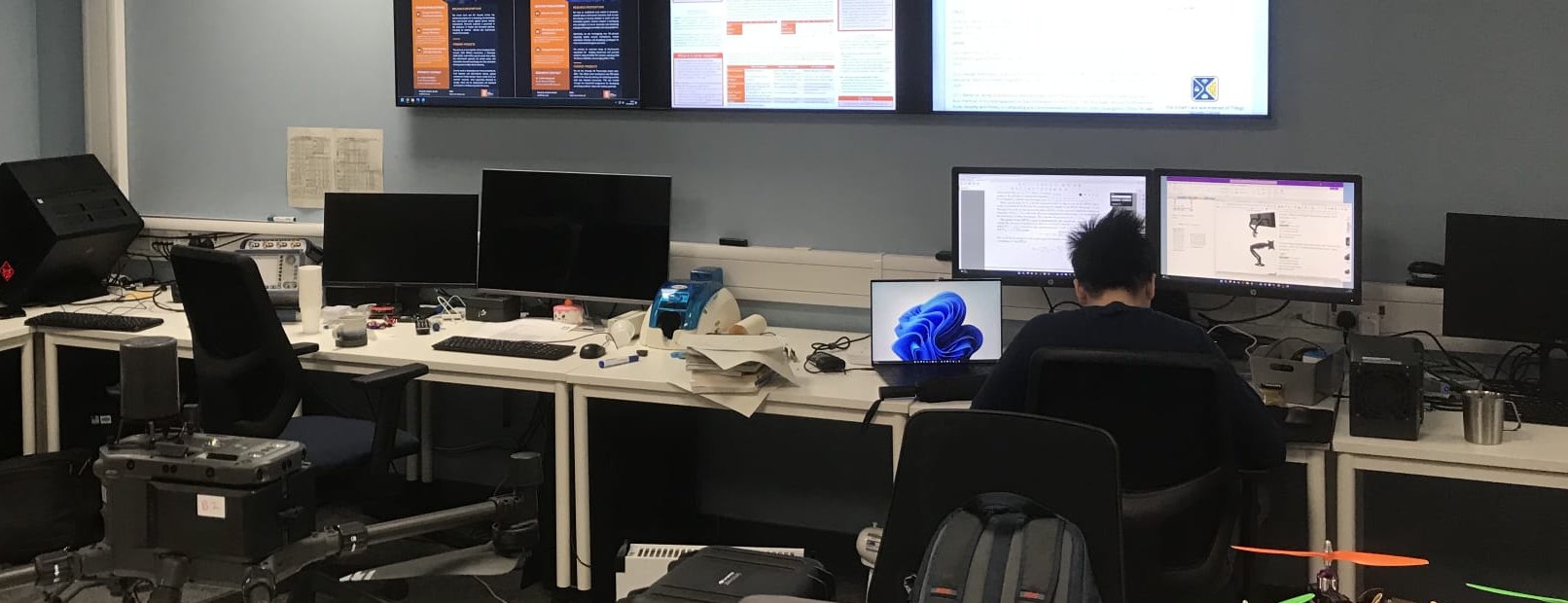
Drone platforms and workstations in the centre’s laboratory

Home  /  News

News

Papers, awards, disclosures and appointments, most recent first.

Vacancies

There are currently no funded research positions available. New opportunities, including PhD, postdoctoral and research assistant positions, will be announced here and on the supervision page.

October 2026

The centre is renamed TASC

After more than twenty years, the Smart Card and IoT Security Centre was renamed the Trustworthy, Embedded and Autonomous Systems Centre. The new name reflects where the work has gone: secure autonomous platforms, embedded AI, telecommunications, digital identity and payments, and media broadcasting security.

Visit the centre

July 2026

Control-flow attestation via symbolic replay

Zhanyu Sha, with Dr Carlton Shepherd and Amir Rafi, released KS-CFA, which performs control-flow attestation by symbolic replay in order to catch control-flow bending attacks — a class that defeats many existing schemes because the hijacked execution still follows a legitimate path through the control-flow graph.

Read the preprint

January 2026

Security and privacy risks in W3C Encrypted Media Extensions

Amir Rafi presented the group’s analysis of the W3C Encrypted Media Extensions standard at IEEE ICSPIS. EME underpins protected playback on every major streaming platform; the paper looks closely at the security and privacy risks that surface in its real deployments.

Read the paper

March 2025

First comprehensive survey of control-flow attestation

Zhanyu Sha, Dr Carlton Shepherd, Amir Rafi and I published a survey of control-flow attestation in Computers & Security. It examines more than thirty schemes published between 2016 and 2024 and sets out a unified framework for reasoning about them, with implications for cloud platforms, cyber-physical systems and IoT devices.

Read the paper

January 2025

A secret sharing approach to packet-based cheating in online games

Yaqi Cai, Dr Carlton Shepherd and I released work on network packet-based cheats in multiplayer online games, proposing a secret sharing approach to make the most common packet manipulations ineffective.

Read the preprint

June 2024

Trusted Execution Environments published by Springer

Dr Carlton Shepherd and I published Trusted Execution Environments, the first book-length treatment of modern TEEs. It runs from smart cards through to Intel SGX and ARM TrustZone, covering architecture, applications and the attestation mechanisms that make them useful.

View on Springer

2024

Covert channels in Android sensor multiplexing

Work with Dr Carlton Shepherd, Dr Jan Kalbantner and Benjamin Semal, published in IEEE Transactions on Dependable and Secure Computing, showed that the way Android multiplexes sensor data opens covert channels and permits application fingerprinting. The issue affects all known Android devices. It was responsibly disclosed to Google and AOSP, who offered a bug bounty; it was declined and given to charity.

Read the paper

2024

Ambient sensors for relay attack detection, reproduced

A reproducibility study in IEEE Access revisited whether ambient sensors can reliably establish proximity in NFC transactions — a question our group first raised in 2016 and one that matters for every contactless payment.

Read the paper

November 2023

First security evaluation of mobile DRM systems

Amir Rafi presented the first domain-specific security evaluation of mobile Digital Rights Management systems at IEEE TrustCom. The study covered Google Widevine, Apple FairPlay and Microsoft PlayReady — deployed on more than five billion devices — deriving a taxonomy of their security features and identifying several weaknesses.

Read the paper

July 2023

The EXFILES project concludes

The EU Horizon 2020 EXFILES project finished after three years developing tools that let law enforcement agencies extract evidence from encrypted mobile devices. It produced the first comprehensive analysis of physical fault injection and side-channel attacks on mobile handsets.

2023

Function recognition from hardware performance counters

Published in IEEE Transactions on Computers, this work showed that hardware performance counters can identify which function is executing inside a compiled library or a trusted execution environment with 86 to 99 per cent accuracy — useful for defence, and a warning for anyone relying on a TEE for confidentiality.

Read the paper

September 2022

Two doctoral students join the group

Amir Rafi joined through the Centre for Doctoral Training in Cyber Security for the Everyday to work on media broadcasting security, having previously been a research assistant on EXFILES. Zhanyu Sha joined to work on software security, trusted execution environments and control-flow attestation.

Meet the students

2022

TensorCrypt selected as a CyberASAP finalist

TensorCrypt, which applies trusted execution environments to confidential data exchange, was a finalist in the Innovate UK CyberASAP programme. The funded proof of concept employed three Royal Holloway undergraduates, and a patent application was filed.

More on commercialisation

2021

Android vulnerability disclosed across all versions

With Dr Carlton Shepherd I discovered a vulnerability affecting all known Android versions across all manufacturers. It was responsibly disclosed to the affected organisation and formally acknowledged, and the findings were shared with our EXFILES project partners.

Disclosure record

April 2021

Best paper and best session awards at IEEE DASC

Vihangi Vagal, Dr Carlton Shepherd and I won both the best paper and the best session award at the 40th IEEE Digital Avionics Systems Conference for our work on complex dynamic geofencing for unmanned aerial vehicles.

2019

Patent application on data provenance for GDPR rights

With Dr Raja Naeem Akram and James Tapsell, a worldwide patent application covering a technique to record an event and its impact on data across that data’s lifetime. It supports the GDPR rights of access, erasure, and rectification with evidence.

Patents

2018

World Economic Forum recognition for blockchain tendering research

Our paper on a fair and transparent blockchain-based tendering framework was independently identified by a World Economic Forum group working on transparency in government procurement. Many of that project’s technical objectives had already been met by the paper.

2018

CVE-2018-10088 assigned a CVSS score of 10.0

An MSc student I supervised found a previously unknown buffer overflow in a digital video recorder. CVE-2018-10088 was assigned a CVSS score of 10.0 — the maximum.

CVE record

↑↓ move↵ openesc close