K. MarkantonakisInformation Security Group, Royal Holloway
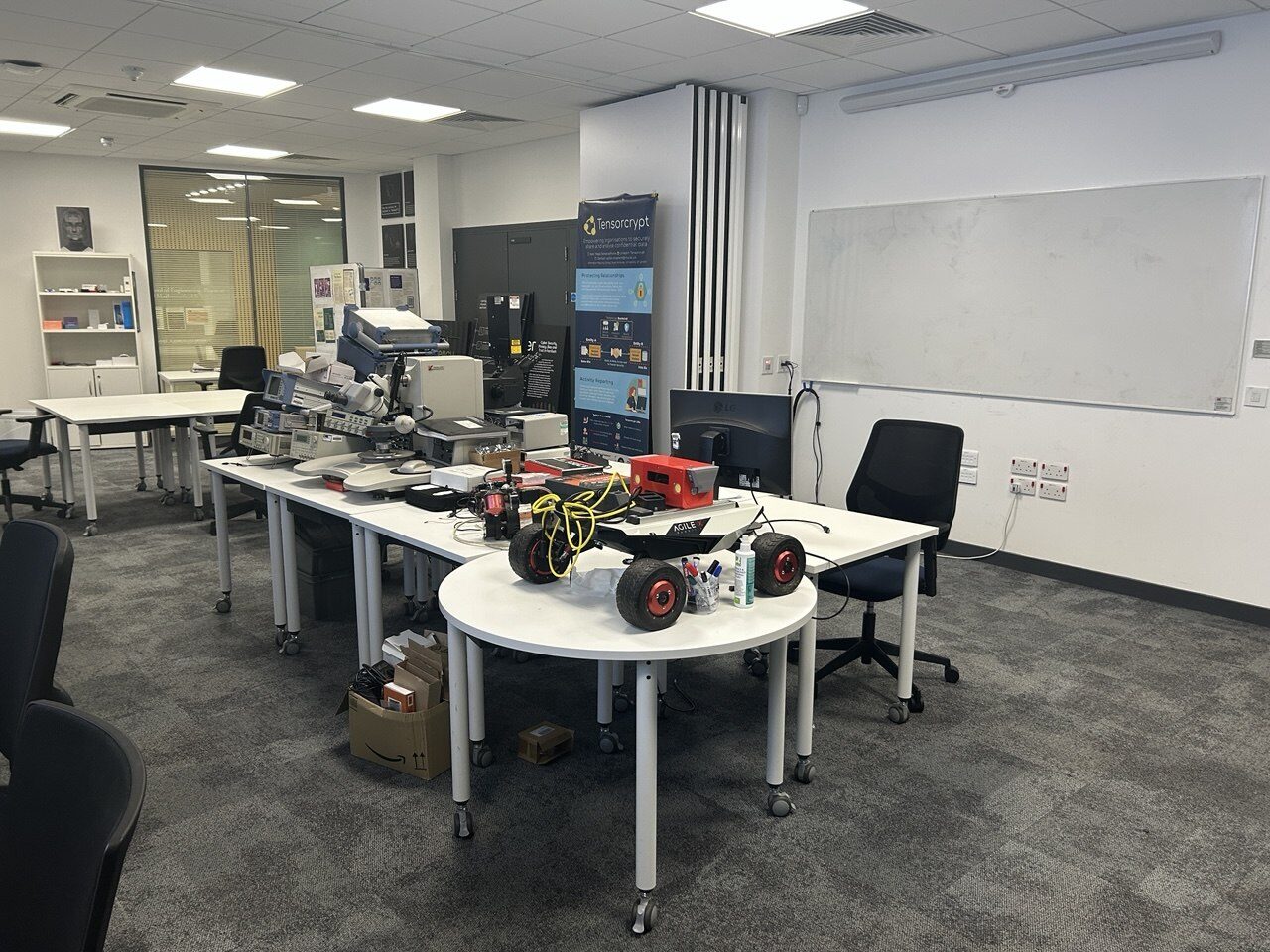
Instruments on a side-channel analysis bench in the centre’s laboratory

Home  /  Research

Research areas

My research explores how secure hardware platforms and trusted execution technologies can be used to protect autonomous and connected systems.

Statement

My research focuses on the security and trustworthiness of connected, embedded and AI-enabled systems. I investigate how trusted execution technologies, platform attestation and secure system architectures can protect sensitive data, software and AI models across their operational lifecycle.

Information security researchers often design systems that perform well in theory but suffer once the characteristics of the operational platform are taken into account. If a system or product is to be considered secure, it is necessary but not sufficient for the design to be theoretically sound: the implementation matters just as much, because attackers target the weakest and most easily accessible parts of a system. Bridging that gap has been a central focus of my work since 1998 — across smart cards, IoT devices, RFIDs, mobile devices, embedded systems, smart contracts, avionics and drones, cyber-physical interfaces, and cloud execution environments.

There is strong potential for impact in these areas, particularly from the growing interest in interconnected devices, industrial control systems, critical national infrastructure, and vehicular and avionics security. More recently the work has extended to memory controller attacks and countermeasures, micro-architectural attacks, automated fuzzing frameworks for ARM IoT devices, mobile phone forensics, and the protection of machine learning models and the data they are trained and run on.

Core themes

Core research themes

These themes run through the work of the Trustworthy, Embedded and Autonomous Systems Centre, and through the greater part of what my students and I publish.

Trusted and confidential computing

Trusted execution environments, platform attestation and hardware-supported protection for sensitive applications, data and AI workloads. Our work spans smart cards, Intel SGX, ARM TrustZone, AMD SEV and Trusted Platform Modules, investigating both their security guarantees and their practical vulnerabilities, and developing approaches to secure enclaves and remote attestation protocols that make trustworthy computation possible in adversarial environments. This work produced the first comprehensive academic textbook on the subject (Springer, 2024).

  • Intel SGX
  • ARM TrustZone
  • TPM
  • Confidential computing

Security and trustworthiness of AI-enabled systems

Protecting AI models, data and decision-making processes in embedded, autonomous and distributed environments, including trusted execution, secure deployment and privacy-preserving collaborative learning. The work covers the integrity of machine learning inference on constrained devices, the protection of models and training data inside trusted execution environments, and the security of federated and consensus-based learning across edge deployments — together with the use of machine learning itself for intrusion detection and threat analysis.

  • Model protection
  • Federated learning
  • Edge AI
  • Privacy-preserving ML

Embedded and automotive security

Security architectures for embedded, connected and autonomous systems, including AI-enabled intrusion detection and collaborative threat analysis. We investigate IoT devices, microcontrollers and resource-constrained platforms where conventional measures are often impractical, including extensive work on RISC-V security. Our automotive work examines in-vehicle networks, ECU security and over-the-air update mechanisms. We work offensively, through side-channel analysis and fault injection, and defensively, through countermeasures, secure boot and authenticated firmware update.

  • RISC-V
  • IoT security
  • Automotive
  • Side-channel

Security of autonomous systems

Trustworthy operation of systems that use AI to sense, decide and act, with emphasis on integrity, resilience and verifiable execution. The theme addresses security where computation meets the physical world: autonomous vehicles, unmanned aerial systems and industrial control. We also research ICS and SCADA security for critical national infrastructure, where a compromised decision has physical consequences.

  • Autonomous vehicles
  • Unmanned systems
  • ICS and SCADA
  • Verifiable execution

Mobile device security

We examine the security architectures of Android and iOS, including their TEE implementations and secure element integrations. We investigate sensor security, including covert channels and device fingerprinting through accelerometers, gyroscopes and other onboard sensors. A significant focus is the analysis of Digital Rights Management systems — Google Widevine, Apple FairPlay and Microsoft PlayReady — and the weaknesses in their protection mechanisms.

  • Android and iOS
  • Widevine
  • Sensor security
  • Mobile TEE

Digital rights management and media security

We investigate the security and privacy implications of digital rights management and media content protection. We analyse widely deployed DRM frameworks and the W3C Encrypted Media Extensions standard that underpins streaming platforms. The work uncovers vulnerabilities in content protection, examines privacy risks in media distribution pipelines, and evaluates the guarantees of the trusted execution environments used to protect decryption keys.

  • DRM systems
  • W3C EME
  • Content protection
  • Streaming security

Platform attestation

Remote attestation lets a verifier establish that a platform is in a known, trustworthy state before sensitive operations proceed. We develop attestation protocols for embedded devices, cloud servers and edge nodes, and investigate control-flow attestation, which verifies runtime behaviour through control-flow integrity checking and so detects sophisticated runtime attacks. This extends to attestation for heterogeneous IoT networks and federated computing, where establishing trust is hardest.

  • Remote attestation
  • Control-flow
  • CFI
  • Trust verification

Avionics and drone security

We address security in aviation and unmanned aerial systems, from commercial drones to safety-critical avionics platforms: communication protocol vulnerabilities, GPS spoofing and jamming countermeasures, flight controller integrity verification, and ground control station security. The work also examines regulatory compliance and the threat landscape of remotely piloted and autonomous aircraft sharing airspace.

  • Drone security
  • GPS spoofing
  • Avionics
  • UAV attestation

Specific topics

Specific areas of investigation

Areas of active investigation, cutting across the core themes above.

Security in payment systems

Contactless payment protocols, EMV standards and tokenisation schemes — identifying vulnerabilities and developing stronger transaction security.

RFID and NFC security

Relay attacks, eavesdropping and proximity verification in radio-frequency identification and near-field communication.

Smart cards and Java Cards

Multi-application platforms, GlobalPlatform security domains and Java Card applet isolation for secure identity and payment applications.

Digital rights management

Security analysis of content protection systems including Widevine, FairPlay and PlayReady, and their TEE-based implementations.

Sensor security and privacy

Covert channels through device sensors, accelerometer-based eavesdropping, fingerprinting, and the privacy implications of ambient sensor data.

Blockchain applications

Decentralised identity, smart contract verification, e-voting, and TEE integration for trusted blockchain oracles.

Privacy-preserving machine learning

Federated learning security, secure multi-party computation for ML, TEE-protected inference, and differential privacy.

Automotive security

In-vehicle network protection across CAN bus and Ethernet, ECU firmware security, keyless entry, and over-the-air update integrity.

Avionics and UAV security

Drone communication protocol security, flight controller attestation, GPS spoofing countermeasures, and safety-critical avionics protection.

Secure firmware updates

Authenticated update protocols for embedded devices, rollback protection, and secure boot chains.

Side-channel analysis

Power analysis, electromagnetic emanations, timing attacks and cache-based side channels used to extract secrets from implementations.

Hardware-intrinsic security

Physically unclonable functions, hardware security modules, true random number generation, and tamper-resistant design.

Transport system security

Ticketing security, transit card vulnerabilities, fare evasion, and protection of critical transport infrastructure.

AI on the edge

Integrity of machine learning inference on constrained devices, model protection in TEEs, and adversarial robustness for embedded AI.

Forensics for embedded systems

Forensic techniques for IoT devices, firmware extraction and analysis, memory forensics on microcontrollers, and evidence preservation.

Video game anti-cheating

TEE-based game integrity protection, client-side attestation for competitive gaming, and cheat detection using trusted computing.

Doctoral study and collaboration

Doctoral study and collaboration

I welcome enquiries from prospective doctoral students and collaborators interested in my research areas, including the security and trustworthiness of AI-enabled systems.

Every theme above is supported by published work. The full record of my publications can be searched by title, author, venue and year from the publications page.

Automotive security test platform in the laboratory
An automotive development platform used for in-vehicle network and ECU security work.
↑↓ move↵ openesc close